Phone: +91-9310885321
 Email: support@learnhub4u.com

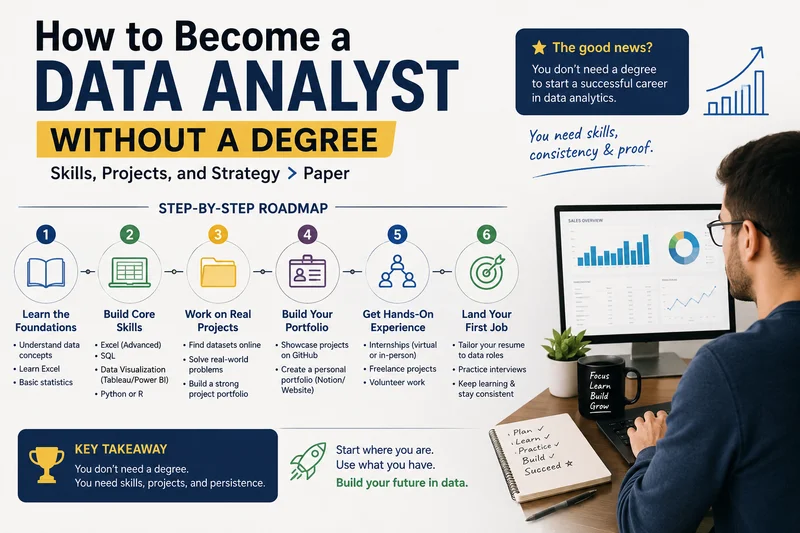
Forget the Degree: How to Actually Land a Data Analyst Job from Scratch
Let’s be completely honest for a second. The tech industry loves to gatekeep. They want you to believe that if you didn't spend four years studying Computer Science at a top university, you have no business looking at data.
They are wrong.
I’m going to tell you a secret that the university marketing departments hate: companies don’t pay you for a piece of paper. They pay you to solve their problems. If a business is losing money because their shipping routes are messed up, they don’t care if you have a diploma or not. They care if you can look at their chaotic spreadsheet and tell them how to fix it.
If you can think logically, ask smart questions, and don't panic when an error message pops up on your screen, you can do this job. Here is the realistic, no-BS roadmap to becoming a data analyst on your own terms, along with how a structured community like Learnhub Education keeps you from losing your mind along the way.
Step 1: Trim the Fat (The Only 3 Tools You Need to Start)
If you Google "how to become a data analyst," you will find articles telling you to learn Python, R, SQL, Tableau, Power BI, Excel, Hadoop, Spark, and advanced machine learning.
Stop. That is the absolute fastest way to burn out and quit before you even start. You are a beginner. You do not need to be a software engineer on day one.
To get your foot in the door for an entry-level role, focus entirely on these three things:
1. Advanced Excel
Don’t roll your eyes. Everyone thinks they know Excel because they can make a bar chart. They don't. Excel is the skeleton of the entire corporate world. If you can master XLOOKUP, Index/Match, and Pivot Tables, you are already more useful to a hiring manager than a computer science graduate who only knows theoretical math. Learn how to clean messy rows, fix typos, and summarize data quickly.
2. SQL (Structured Query Language)
Excel handles data on your laptop. SQL handles data stored on a massive server. This is the absolute most critical technical skill you will learn. The good news? It reads almost like plain English. You are basically just telling a database: "Hey, show me the top 10 customers from New York who spent money today." Master SELECT, WHERE, GROUP BY, and how to JOIN different tables together.
3. Tableau or Power BI
Managers don’t want to look at columns of numbers; they want to see a story. These tools let you turn your SQL queries into interactive dashboards. Pick one and stick to it. Don't waste time trying to learn both. Power BI is usually easier if you already know Excel.
Step 2: Build a Portfolio That Doesn’t Look Boring
Since you don’t have a degree, your portfolio is your only proof that you aren't lying on your resume. It needs to be great.
But here is where 90% of self-taught students mess up: they go to Kaggle, download the "Titanic survival dataset" or the "Iris flower dataset," and copy a tutorial. Recruiters see these exact same projects fifty times a day. It instantly tells them you just followed instructions without thinking.
You need to build projects about things you actually care about.
The Hobby Project: Are you obsessed with video games? Analyze the player data of your favorite game to see which strategies actually win. Love fitness? Export your Apple Watch data and look for patterns in your sleep vs. your workouts.
The Local Business Project: Go to a local business—like a gym or a coffee shop owned by a family friend. Ask them if you can look at their anonymous sales data from last year. Find out what their slowest day of the week is, or which product isn't making money. Put that in your portfolio.
When you write about your projects, don't just show your code. Explain your thought process: What was the problem? How did I clean the messy data? What is my recommendation to the business?
Step 3: Escaping "Tutorial Hell" with Learnhub Education
It is incredibly easy to get stuck in what developers call "tutorial hell." This is when you spend six months watching YouTube videos or doing cheap online courses, feeling like you’re learning, but the moment you open a blank screen to start your own project, your brain freezes. You don't know what to do because nobody is giving you the answers anymore.
This is exactly why Learnhub Education was built.
Learning on your own is lonely and frustrating. When you get a random syntax error in your SQL code at 11 PM, Google won't always help you. You need a human. Learnhub Education bridges that gap by giving you a structured path. Instead of just giving you videos to watch, they focus on project-based learning with actual mentorship.
You get to work on real-world scenarios, get your code reviewed by people who work in the industry, and stay accountable. It turns a confusing guessing game into a clear, day-by-day checklist.
Step 4: The Network Hustle (Bypassing the HR Robots)
Let’s talk strategy. If you just go to LinkedIn or Indeed, find a job posting, and hit "Easy Apply," your resume is going to a black hole. Large companies use automated scanners that look for keywords. If the scanner doesn't see "Bachelor’s Degree in Math/CS," it deletes your application before a human ever looks at it.
You have to play a different game. You have to talk to real humans.
Stop asking for jobs; ask for advice. Find data analysts on LinkedIn who work at companies you like. Send them a short message: "Hey Sam, I saw your post about your latest dashboard. I’m currently teaching myself SQL and love your style. Do you have 10 minutes for a quick virtual coffee? I’d love to know what skill you actually use the most on a typical Monday."
Show your work publicly. Every time you finish a project, or even when you just solve a really annoying bug in your code, post about it on LinkedIn. Write a short paragraph explaining what you learned. Hiring managers scroll through LinkedIn looking for people who are passionate, driven, and active. Let them find you.
Step 5: Own Your Story in the Interview
When you finally sit down for an interview, do not try to apologize for not having a degree. Don't act embarrassed about it. Own it.
Turn it into your greatest strength. Tell them: "I don't have a degree because I chose to teach myself. While other students were sitting in lecture halls memorizing theories from ten years ago, I was building real projects, cleaning messy real-world datasets, and learning the exact tools your team uses today. I’m here because I actually love solving data problems, not because I passed a test."
Managers love grit. They love people who can figure things out on their own.
The Bottom Line
Breaking into data analytics without a college degree isn't the easy way out. It takes discipline, a lot of patience, and the willingness to fail repeatedly until your code finally works.
But it is 100% possible. Stop waiting for a piece of paper to give you permission to start your career. Build your skills, use platforms like Learnhub Education to stay on track, put yourself out there, and go get your first role. You've got this.
FAQs
1. Will companies actually hire me if I don’t have a degree?
Yes, they will. Look, startups and mid-sized companies care about one thing: can you do the work on Monday morning without making a mess? They don't want to spend three months training someone who knows theoretical computer science but can't build a basic chart. If your portfolio shows you can clean their ugly data and make a dashboard that saves them money, you're ahead of half the college grads out there.
2. Do I need to be a math genius to do this?
Not at all. You don’t need calculus, trigonometry, or crazy algebra. If you know how to find an average, understand percentages, and know what a median is, you’re fine. The software tools handle the heavy math. Your job isn't to calculate the numbers by hand; your job is to look at the result and explain what it means for the business.
3. Should I learn Excel or Python first?
Start with Excel. Don't listen to the tech snobs who say Excel is dead—the entire corporate world runs on it. Excel lets you actually see your data in rows and columns right in front of your face. Once you get how pivot tables and basic formulas handle data, switching over to code like SQL or Python makes way more sense.
4. What’s the deal with Tableau vs. Power BI? Which one do I pick?
They do the exact same thing: they turn ugly tables of numbers into visual charts. It’s like picking between an iPhone and an Android. Power BI is a Microsoft tool, so if you already know Excel, it feels very familiar. Tableau is great for making things look pretty. Just pick one and get good at it. Do not waste your time trying to learn both at the same time.
5. How long does it realistically take to get a job?
If you are starting from absolute zero, give yourself 6 to 12 months of daily, consistent practice. Anyone telling you that you can become a job-ready analyst in a 4-week bootcamp is just trying to take your money. It takes time to build the muscle memory for writing code and to actually understand how businesses use data.
6. What do I put in a portfolio if I’ve never had a data job?
Build projects around stuff you actually care about. If you love fitness, download your own workout data and look for trends. If you love video games, scrape player stats. You want three main projects: one where you take a really messy dataset and clean it up, one clean dashboard, and a short, one-page write-up explaining a business decision based on that data.
7. Can I just use Kaggle datasets for my portfolio?
You can use them for practice, but please don't put the famous ones on your resume. Every recruiter on earth has seen the Titanic survival dataset and the Iris flower dataset thousands of times. The moment they see those on your portfolio, they know you just copied a standard online tutorial. Find unique, weird datasets instead.
8. What is "tutorial hell" and how do I get out of it?
Tutorial hell is when you spend months watching videos, copying exactly what the instructor does, and feeling smart. But the second you close the video and look at a blank screen, your brain freezes. You get out of it by building something on your own immediately after a lesson. Watch a 20-minute video, then spend an hour building something different with the same tool. Get stuck, break things, and fix them. That’s real learning.
9. How does Learnhub Education help if I'm studying alone?
Teaching yourself through random YouTube videos is lonely, and it’s incredibly easy to quit when you get stuck. When your SQL code throws a weird error at midnight, Google won't always have the answer. Learnhub Education gives you a straight path so you don't waste time wondering what to learn next, plus you get actual human mentors to look at your code and a community to keep you from giving up.
10. Do I need an expensive computer?
No. You don't need a heavy gaming laptop or a top-tier Mac. As long as your computer can run a web browser, load Excel, and doesn't crash when you have ten tabs open, you are good to go. Most massive data work happens on cloud servers anyway, not your personal hard drive.