Phone: +91-9310885321
 Email: support@learnhub4u.com

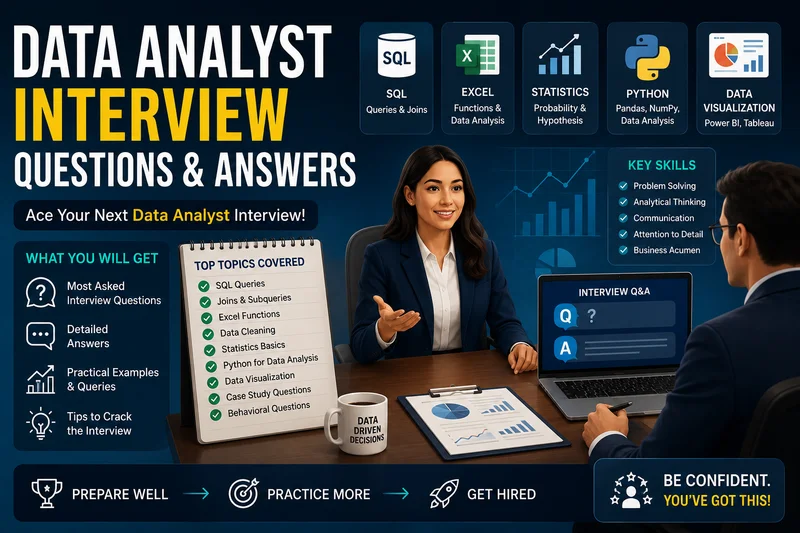
Cracking the Data Analyst Interview: What They Actually Ask (And How to Answer)
Sitting down for a data analyst interview is nerve-wracking. You’ve probably spent weeks cleaning messy datasets, writing SQL queries until your eyes hurt, and messing around with dashboards in Power BI. But when an interviewer sits across from you and asks a basic question, it’s surprisingly easy to freeze up.
At Learnhub Education, I see this happen all the time. Smart students who know their stuff technically end up getting tripped up because they try to recite answers like a textbook. Here’s the secret: interviewers don’t want a textbook. They want to see how you think, how you handle problems when things go wrong, and whether you can actually talk to human beings about numbers.
Let's walk through the questions you’ll almost certainly run into, along with how to talk through them naturally.
The Technical Stuff (Without Sounding Like a Robot)
1. "What’s the difference between WHERE and HAVING in SQL?"
This one comes up constantly. The biggest mistake people make here is overcomplicating it.
Keep it simple. It all comes down to when the filtering happens.
WHERE filters individual rows before any grouping happens.
HAVING filters data after you’ve grouped it together using GROUP BY.
A quick example makes this instantly clear to an interviewer:
If you want to pull a list of customers who live in Chicago, you use WHERE city = 'Chicago'. But if you want to find customer groups who have spent more than $1,000 overall, you have to group them first, so you use HAVING SUM(order_value) > 1000.
That’s it. Short, sweet, and to the point.
2. "How do you handle messy or missing data?"
Real-world data is almost always a disaster. Interviewers ask this to make sure you won't panic when a dataset isn't handed to you on a silver platter.
Don't just list data-cleaning commands. Walk them through your thought process:
First, check the damage: Is 1% of the column missing, or is it 50%? That changes everything.
Figure out why it’s missing: Is it just random human error, or did a field on a website break and stop collecting data?
Decide what to do:
If it's a tiny drop in the bucket, you might just drop those rows.
If it's numbers, replacing missing values with the median or mean usually works well (as long as there aren't crazy outliers).
If it's categories, replacing blanks with "Unknown" keeps things neat.
Fix the formatting: Clean up typos, remove trailing spaces, and standardise things like dates and text.
3. "Can you explain the difference between JOINS?"
Every single data interview will test you on joins. Instead of memorizing Venn diagrams, explain what actually happens to the data you end up with.
Inner Join: Gives you only the records that match in both tables. If a customer ID exists in Table A but not Table B, it gets thrown out.
Left Join: Takes everything from the left table, and pulls in matching info from the right table. If there’s no match on the right, it just leaves a blank (NULL).
Right Join: The exact opposite of a left join. (To be honest, most analysts just flip their tables around and stick to Left Joins, and saying that out loud in an interview actually makes you sound experienced!)
Scenario Questions: How You Actually Think
4. "Tell me about a time your data gave you a weird or unexpected result."
This is a classic. They want to know if you blindly trust whatever the code spits out, or if you actually double-check your work.
Pick a project you worked on and talk through it step by step:
What were you trying to find?
What went weird? (For example, maybe sales dropped off a cliff on a Tuesday, or a specific age group suddenly spiked).
How did you investigate it? Did you check for duplicate rows? Did you talk to someone on the sales team to see if there was an app crash that day?
Ending with a lesson you learned shows high maturity.
5. "How do you explain technical findings to non-technical people?"
As an analyst, half your job is doing the technical work. The other half is explaining it to managers, stakeholders, or clients who don't care about SQL syntax or complex algorithms—they just want to know what to do next.
A great way to answer this:
"I cut out the jargon completely and focus on the bottom line. Business leaders don't usually need to know the exact steps of my query—they want to know what the numbers mean for the company. I like to use visual charts, keep text minimal, and always link the data back to a real business outcome, like saving money or keeping customers happy."
A Few Real-World Tips for Interview Day
Whenever we run mock interviews at Learnhub Education, these three simple habits instantly make candidates stand out:
Think out loud. If they give you a problem to solve on the spot, don't sit there in dead silence for two minutes. Talk through your logic as you go. They care much more about how your brain works than getting a perfect final number.
Be honest when you're stuck. If someone asks you about a tool or Python library you haven't used yet, just say so! Say, "I haven't worked with that specific library yet, but here's how I'd go about learning it or solving the problem with what I do know." That honesty goes a long way.
Bring real stories. Try to anchor your answers in actual projects you worked on, whether from a course, a bootcamp, or a past job. Abstract theory is forgettable; actual project stories stick in an interviewer's mind.
Final Words
At the end of the day, a data analyst interview isn't a pop quiz to see if you've memorized the entire dictionary of data science. It's a conversation to see if you're curious, logical, and easy to work with. Practice explaining these concepts in your own words, trust the work you've put in, and go in there ready to show them how you solve real problems.
FAQs:
1. Do I need a math or CS degree to actually get hired?
Honestly, no. Having one might get your resume noticed five seconds faster, but hiring managers care way more about whether you can do the actual work. If you can clean a messy spreadsheet, write a solid SQL query, and explain your dashboard without putting everyone to sleep, nobody is going to care what your degree was in.
2. Should I learn Python or R first?
Stick with Python. R is great if you are doing academic research or heavy statistical modeling, but almost every tech company, startup, and traditional corporate team uses Python. Plus, Python is much easier to read when you're just starting out.
3. Is Excel still worth learning, or is it outdated?
Excel isn't going anywhere. People have been predicting its death for fifteen years, but every company still runs on it. Managers love quick Excel sheets for fast checks and simple charts. Get comfortable with Pivot Tables and XLOOKUP before you worry about anything more complex.
4. Power BI or Tableau—which one should I pick?
Pick whichever one looks easier to you and stick with it. The underlying rules—how you pick a chart, build a layout, and set up filters—are identical in both. Power BI is really common in corporate offices because it integrates with Microsoft, while Tableau pops up a lot in tech startups. Once you know one, switching to the other later takes a weekend.
5. What should I put in a portfolio if I have zero work experience?
Pick datasets about things you actually care about—like sports stats, housing prices, or movie ratings—and stay away from overused student datasets like the Titanic survivor list. Show the whole process: show how gross the raw data was, how you cleaned it up, and a quick dashboard showing 2 or 3 interesting things you found.
6. How many projects do I need to show on my portfolio?
Two or three good ones are plenty. Having ten copy-pasted projects from a tutorial just tells an interviewer you know how to follow instructions. Two deep, messy projects where you explain your decisions will impress people way more.
7. What soft skills actually matter for this job?
Curiosity and plain talking. You need enough curiosity to notice when a number looks weird and dig into it, and you need to be able to explain what you found to a manager without using confusing jargon.
8. How do I survive a live SQL test in an interview?
Talk out loud while you write your query. If you sit in total silence, the interviewer has no idea if you're stuck or just typing. If you talk through your logic out loud, they can see how you think—and they'll often give you a gentle nudge if you're heading down the wrong path.