Phone: +91-9310885321
 Email: support@learnhub4u.com

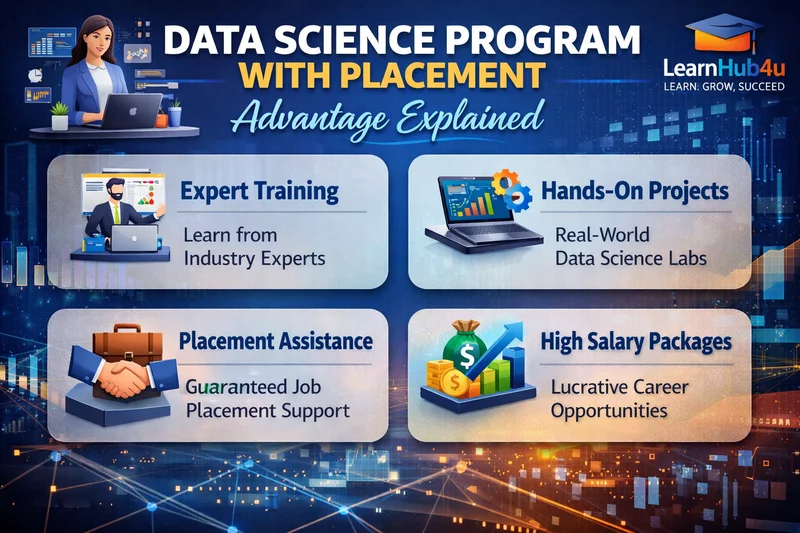
Look, let’s be honest. It’s 2026, and everyone and their cousin is trying to become a Data Scientist. You’ve probably seen the ads: "Become a Pro in 4 Weeks!" or "Earn 50 LPA Overnight!" It’s exhausting, isn't it? The truth is, the market is crowded, but it's not actually full. It’s only full of people who know how to run a basic Python script they found on a tutorial. Companies today aren't looking for "script-runners." They are looking for problem solvers who can actually handle a messy, real-world database without calling for help every five minutes.
That’s where we come in. At Learnhub, we’ve spent years figuring out exactly where students trip up. We don't just give you a login to a dashboard and wish you luck. We’ve built a system at Learnhub Education that focuses on the "grit" of data—the stuff that actually happens when you’re on the job.
We Threw Out the "Textbook" Curriculum
Most programs are still teaching data science like it’s 2021. But in 2026, the game has changed. If you aren't talking about Generative AI (GenAI), Agentic workflows, and LLM fine-tuning, you’re already behind.
Our curriculum isn't just a list of topics; it’s a living document updated by people who actually work at places like PayPal, Deloitte, and Nagarro. We start with the foundations—Python and SQL—but we move fast into the heavy hitters: Advanced Machine Learning, Deep Learning, and the 2026 essentials like Retrieval-Augmented Generation (RAG). Why? Because when you’re in an interview, and they ask how you’d optimize a chatbot for a retail giant, "I know Linear Regression" isn't going to cut it. You need to know how the modern stack actually fits together.
The "Dirty Data" Philosophy
Here’s a secret: In most courses, the data you get is clean. It’s perfect. It’s "sanitized." In the real world? Data is a nightmare. It’s missing half its values, the dates are in three different formats, and half the entries are duplicates.
At Learnhub Education, we don't give you clean data. Our Capstone projects are built on "dirty" datasets scraped from real-world sources. You’ll spend weeks just cleaning and wrangling before you even build a model. It’s frustrating, sure. But it’s exactly what a job feels like. When you can show an employer a GitHub repo where you took a chaotic mess of raw data and turned it into a predictive model for Investment Banking risk, they stop looking at your certificate and start looking at you.
Mentorship That Actually Answers the Phone
We’ve all been there—stuck on a line of code at 11 PM, wondering why your model's accuracy is stuck at 50%. You post on a forum and wait three days for a reply. That doesn't happen here.
One of the biggest pillars of the Learnhub experience is our 1:1 mentorship. We’re talking about unlimited doubt-clearing sessions with guys like Nitin Sir and Riaz Sir. These aren't just "tutors"; they are veterans who have seen it all. They don't just give you the answer; they teach you how to find it. That’s the "Data Scientist Mindset" we keep talking about. It’s about learning to debug your own brain as much as your code.
Moving Beyond the "Math Wall"
Let’s talk about the elephant in the room: Statistics. A lot of people quit because they hit the "Math Wall." They see a formula for Bayesian probability and think, "Maybe I’ll just stay in my current job."
We get it. Math can be scary if it’s taught like a dry university lecture. But at Learnhub, we teach math through action. You learn statistics because you need it to understand why your A/B test is failing. You learn Linear Algebra because you need to understand how your image recognition model "sees." When math has a purpose, it stops being a hurdle and starts being a tool.
The Career Launchpad (Not Just a Job Board)
Getting hired is a skill in itself. You could be the best coder in India, but if your LinkedIn looks like a ghost town and your resume is five pages long, nobody is going to call you.
Our 360° Placement Assistance is a bit of a "bootcamp" within a bootcamp. We do mock interviews with real hiring managers—the kind of people who will actually be across the table from you. We help you with "Data Storytelling," which is just a fancy way of saying "explaining your math to a boss who hates math." We’ve partnered with over 400 companies—from startups to MAANG—to make sure our 12,000+ alumni don't just get a "job," but a career.
Think about it this way: Our graduates have seen an average salary hike of 87%, with some hitting packages as high as 48 LPA. That’s not a coincidence; it’s the result of a very specific, very intense preparation process.
Why This Actually Works
You might be wondering: "Is this for me?" Maybe you’re a BCA grad, or maybe you’ve been in tech support for five years and you’re bored out of your mind.
The reason Learnhub Education works is that we treat you like a professional from Day 1. We don’t "teach" you; we "train" you. We focus on the things that actually matter in 2026:
Business Reporting: Can you write a report that a CEO can understand in 30 seconds?
Soft Skills: Can you lead a team meeting without sounding like a robot?
Agile Mindset: Can you pivot when a project’s requirements change overnight?
These are the "unspoken truths" of the industry. They aren't on the syllabus of most online courses, but they are the reason our students get hired while others are still sending out 100 resumes a day with no luck.
Your Next Chapter Starts Now
The data science market in 2026 is rewarding the bold. It’s rewarding the builders. If you’re tired of "collecting certificates" and you’re ready to actually build something, you’re in the right place. Learnhub isn't just another platform; it’s a community of 12,000+ people who decided they wanted more from their careers.
Stop waiting for the "perfect time" to start. Visit Learnhub today, check out our upcoming batches, and let's get to work on your career transformation.
FAQs
1. "I’m not a math genius. Is the statistics part going to be a nightmare?"
Not at all. You don’t need to be a mathematician, but you can’t ignore the logic. The program focuses on applied statistics—meaning you learn how to use math to solve business problems, like A/B testing or hypothesis testing, rather than just solving abstract equations on a chalkboard.
2. "Will the placement team actually help me, or just send me links to LinkedIn?"
The "360-degree support" is active, not passive. It includes 1:1 mock interviews with mentors from top tech companies and profile optimization. They don't just find the jobs; they make sure your resume actually clears the ATS (Applicant Tracking System) filters that usually block beginners.
3. "I have a non-tech background (Sales/HR/Admin). Am I going to be lost?"
Many alumni have switched from roles like Graphic Design or Claim Analysis. The curriculum starts with the basics of Python and SQL. The "bridge" is the domain knowledge you already have—companies love a Data Scientist who understands how a business actually functions.
4. "Is the certification really recognized by recruiters?"
While the certificate proves you completed the rigors of the program, most recruiters in this field care more about your Portfolio. The real "advantage" here is the industry-recognized certification paired with the GitHub projects you’ll build during the course.
5. "What if I get stuck on a coding bug at 10 PM?"
This is where the "Unlimited 1:1 Doubt Clearing" comes in. Instead of spending three days stuck on a single line of code, you can get personalized help to understand why the error happened, which is how you actually learn to debug like a pro.
6. "How much time do I honestly need to commit every week?"
To really see the 80-100% salary hikes mentioned by alumni, you should aim for at least 10–15 hours a week. It’s designed for working professionals, so it’s flexible, but the "hands-on" projects require genuine seat time.
7. "Will I learn Generative AI, or is it just old-school Machine Learning?"
The curriculum is updated for 2026, meaning it includes Generative AI and LLMs. You’ll learn how to use AI tools to speed up your workflow (like data cleaning) so you can focus on the high-level strategy that AI can't do yet.