Phone: +91-9310885321
 Email: support@learnhub4u.com

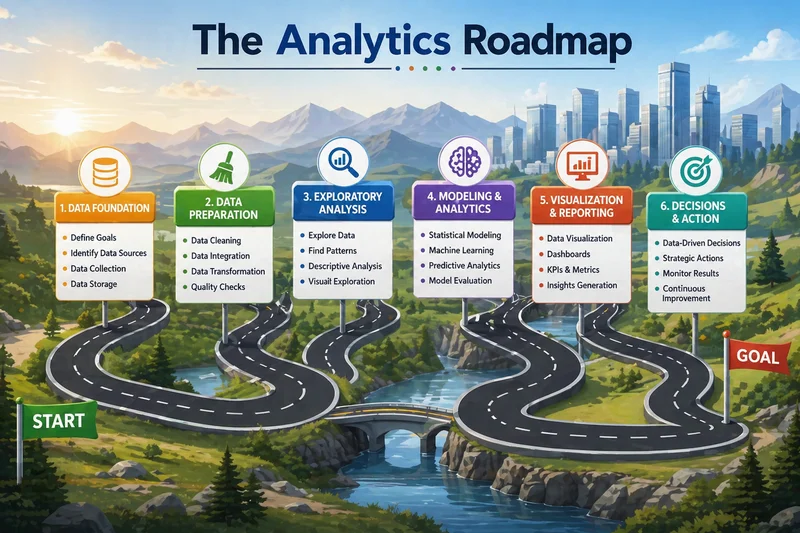
If you have spent any time looking for a way into the data world, you have probably felt overwhelmed. One website tells you that you need to be a math genius. Another says you need to master three different programming languages before you can even apply for an internship. At Learnhub Education, we see this confusion every single day, and honestly? It’s mostly just noise.
The truth is, the "perfect" roadmap doesn't exist in a textbook. It exists in the balance between technical skill and business common sense. This guide is a look at how you actually get from point A to a paycheck in the Indian data market.
The Mindset: Problem Solving Over Tools
The biggest mistake we see at Learnhub Education is students falling in love with the tools instead of the problems. You might spend weeks learning every single button in Power BI, but if you don't understand why a business needs a dashboard, you aren't an analyst—you’re just a software operator.
Before you touch a computer, start asking "Why?" Why does a company like Zomato care about delivery times? Why does an e-commerce site care about "Cart Abandonment"? When you start thinking about the business goal, the data starts to make sense.
The Foundation: Excel and the Power of Logic
There is a strange trend where people act like Excel is "old-fashioned." At Learnhub Education, we disagree. Excel is the most successful data tool in history for a reason. It forces you to look at the data row by row and understand how it’s structured.
You don’t need to know every single one of the 500+ functions. You need to master Pivot Tables, VLOOKUP (and XLOOKUP), and basic logical formulas (IF/AND/OR). If you can’t clean a messy list of 1,000 customers in Excel, you’ll be completely lost when you have to clean 1,000,000 rows in a database.
The Language of Data: SQL
If Excel is the foundation, SQL is the walls of the house. This is where most people get intimidated, but it’s actually the most "human" programming language there is. It reads almost like English.
In the Indian job market—whether you are looking in Bengaluru, Pune, or Noida—SQL is the "Gatekeeper" skill. If you can't write a query to pull specific data from a database, you can't do the job. At Learnhub Education, we focus heavily on "Joins" and "Aggregations." Why? Because in the real world, data is never in one place. It’s scattered across different tables, and your job is to stitch it together.
Visual Storytelling: Power BI & Tableau
Numbers are boring to most people. Your manager or your client doesn’t want to see a table of 50,000 sales transactions. They want to see a trend line that shows them if they are making a profit or a loss.
This is where Data Visualization comes in. Pick either Power BI or Tableau (don't try to learn both at the same time). The goal here isn't just to make "pretty" charts. It’s about "Data Ink." Every line and color on your dashboard should have a purpose. If a chart doesn't help someone make a decision, delete it.
The "Real" Programming: Python
Once you are comfortable with SQL and Dashboards, it’s time to talk about Python. You don't need to become a developer. You just need to learn how to use Python as a "Super-Excel."
With libraries like Pandas and NumPy, you can do things that would crash a spreadsheet. You can automate the boring, repetitive parts of your job. Imagine taking a task that used to take you all Monday morning and turning it into a script that runs in five seconds. That is the value you bring to a company.
Building Your "Human" Portfolio
Stop using the "Titanic" or "Iris" datasets for your projects. Every recruiter has seen them. If you want to stand out, you need to find data that actually matters to you.
At Learnhub Education, we encourage students to look for local data. Maybe it’s an analysis of IPL player stats, or the fluctuations in fuel prices in India over the last decade, or even the growth of startups in your city. When you talk about a project you actually care about, it shows in the interview. You speak with passion, and that is what gets you hired.
The Career Path and Salaries in India
Let’s talk about the reality of the market. The demand for data talent in India is at an all-time high, but so is the competition.
Junior Analyst: You’re likely looking at a range of ₹4L to ₹7L per year.
Mid-Level/Senior: Once you have 3–5 years of experience and can lead a team, that number often jumps to ₹12L–₹20L+.
But the money follows the skill. Companies aren't looking for certificates; they are looking for "Proof of Work." Can you solve the problem? Can you explain the data? Can you help the company grow?
The Final Step: Continuous Curiosity
The roadmap for data analytics never really ends. Tools change. Last year it was all about Big Data; this year it’s all about Generative AI. But the fundamentals—logic, SQL, and storytelling—never change.
At Learnhub Education, we don’t just teach you how to click buttons. We teach you how to think. We believe that anyone with curiosity and a bit of grit can build a massive career in this field. It’s not about being the smartest person in the room; it’s about being the one who refuses to stop asking questions until the data gives up its secrets.
Ready to start your journey?
The path is clear, but you don't have to walk it alone. At Learnhub Education, we specialize in taking you from "zero" to "job-ready" with practical, hands-on training that actually makes sense.
FAQs
1. Do I really need to be a math genius to learn Data Analytics?
Honestly? No. You don’t need to know advanced calculus or trigonometry. You do need to be comfortable with "school-level" math—things like percentages, averages, and basic probability. If you can understand a profit-and-loss statement, you have enough math to start.
2. Is a degree in Computer Science (B.Tech/BCA) mandatory?
It helps, but it’s definitely not a dealbreaker anymore. We’ve seen B.Com, MBA, and even Arts graduates transition into data roles. Companies in India are shifting their focus toward "what you can do" rather than "what your degree says."
3. Which tool should I learn first: SQL or Python?
Learn SQL first. In a real job, your first task is usually just getting the data out of a database. You can’t use Python if you can't even get the data into your environment. SQL is the "bread and butter" of the industry.
4. How much time does it actually take to become job-ready?
If you are consistent and spend about 10–12 hours a week, you can build a solid foundation in 4 to 6 months. Anyone promising to make you an "expert" in 30 days is likely selling you a dream that doesn't exist.
5. Are certifications worth it?
A certificate is just a piece of paper. What’s actually worth it is the portfolio you build while earning that certificate. A recruiter might glance at your certificate, but they will spend ten minutes looking at a project where you solved a real business problem.
6. I’m from a non-tech background. Will companies even look at my resume?
Yes, but you have to play to your strengths. If you come from a Finance background, apply for "Financial Analyst" roles. Your "Domain Knowledge" is a massive advantage—you already understand the business side, which many techies struggle with.
7. What is the difference between a Data Analyst and a Data Scientist?
Think of a Data Analyst as the person who explains what happened and what is happening now. A Data Scientist uses more complex coding to predict what will happen in the future. Most people should start as an analyst before trying to become a scientist.
8. Is Excel still relevant in 2026?
Absolutely. You’ll be surprised how many multi-million dollar decisions in top Indian firms are still made based on an Excel sheet. It’s the fastest tool for quick analysis. Never skip it.
9. Which visualization tool is better: Power BI or Tableau?
It’s like asking "Android or iPhone?" Both do the same thing. Power BI is more common in companies that use Microsoft tools, and it's slightly easier to learn. Tableau is often preferred for very complex, high-end visual storytelling. Pick one and stick to it; the skills are transferable.
10. How do I find "real" projects for my portfolio?
Look around you! Use data from the Indian Census, the RBI, or even your own LinkedIn export. At Learnhub Education, we always tell students: a "small" project with a "big" insight is better than a complex project that nobody understands