Phone: +91-9310885321
 Email: support@learnhub4u.com

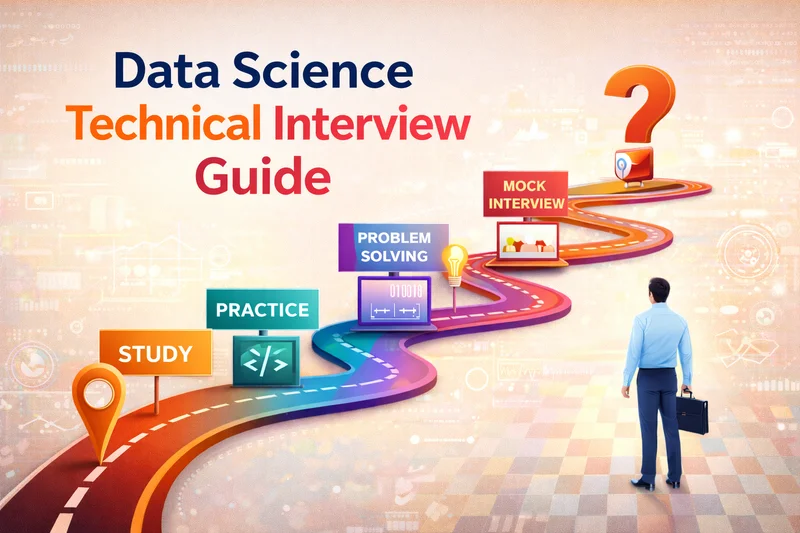
Let’s be real , the "Technical Interview" for Data Science in 2026 has become a bit of a beast. You can have a killer GitHub and a resume that glows, but the second a senior dev asks you to explain the bias-variance tradeoff while live-coding a SQL join, things get sweaty. It’s not just about what you know anymore; it’s about how you think under pressure. At Learnhub Education, we’ve seen the shift firsthand. Companies aren't just hiring "calculators" who can run a model; they’re looking for "storytellers" who happen to be great at math. If you want to actually land the job, you need to stop memorizing and start internalizing.
The "SQL First" Trap
Most juniors spend months obsessing over Neural Networks and then fail the first 20 minutes of the interview because they couldn't write a window function in SQL. Here’s the truth: most of your professional life is data cleaning. If your SQL is shaky, your interview ends before the "cool" AI questions even start. You need to be fast, fluid, and logical with your queries.
Beyond the "Black Box"
If you tell an interviewer you used XGBoost "because it’s the best," you’ve already lost. You need to explain the mechanics. Why did you choose it? How did you handle the outliers? Statistics isn't just a hurdle to jump over; it’s the language of the job. You should be able to explain a p-value to a CEO and a developer with the same level of confidence. This is a core philosophy we push at Learnhub Education.
How Learnhub4u Education Gets You "Interview-Ready"
We don't believe in just watching videos and checking boxes. At Learnhub Education, we put our learners through the ringer with "Pressure-Test" mock interviews. Our approach focuses on the messy, real-world scenarios that textbooks ignore. We assign you a raw, "dirty" dataset,the kind you’d actually find in a corporate database and ask you to find the business value in under two hours. Our mentors at Learnhub Education then tear down your presentation, not to be mean, but to show you exactly where an interviewer will poke holes in your logic. This hands-on, often grueling preparation at Learnhub Education ensures that by the time you're in a high-stakes interview at a Top-Tech firm, you’ve already answered the hardest questions three times over.
The "Explain it to a Five-Year-Old" Rule
One of the biggest red flags for recruiters is a candidate who hides behind jargon. If you can't explain "overfitting" without using the word "stochastic," you probably don't understand it well enough. At Learnhub Education, we focus heavily on the communication aspect. We want our students to be able to sit in a boardroom and explain why a certain model is losing the company money without boring everyone to tears.
Don't Forget the "New" Basics: GenAI & MLOps
It’s 2026,if you aren’t talking about model deployment or how you’d prompt-engineer an LLM for a specific task, you’re behind the curve. Interviewers now expect you to know how a model lives in the "wild." Can you containerize it? How do you monitor for data drift? These are the questions that separate the $80k roles from the $180k roles.
Your Game Plan
Before you head into that Zoom call, remember:
Company Context: If it’s a fintech company, don't talk about image recognition. Talk about risk and fraud.
The "Why" Over the "What": Every line of code you write should have a business reason behind it.
Stay Human: Interviewers hire people they want to work with. Show some personality, admit when you don't know an answer, and explain how you'd go about finding it.
At the end of the day, preparation is about building an intuition, not just a library of facts. Through the specialized training at Learnhub Education, we make sure that intuition becomes second nature. You've got the drive; now you just need the right strategy. Learnhub Education is here to make sure you don't just get the interview, you get the offer.
CONCLUSION
Look, at the end of the day, passing a data science interview in 2026 isn't about being a human calculator; it’s about showing you have the "grit" to handle messy, real-world data that doesn't follow textbook rules. The industry has moved past hiring people who just copy-paste functions from documentation. They want investigators people who see a skewed distribution and immediately think about the underlying business risk rather than just a math hurdle. This mindset shift is exactly why we prioritize a high-pressure, "sink or swim" approach at Learnhub Education. We don't want you to just survive the technical round; we want you to own it.
By sharpening your narrative and building that raw technical intuition through the hands-on mentorship at Learnhub Education, you stop being just another "applicant" and start being a high-value asset. Every time you hit a wall during a live-coding session, it’s actually a massive opportunity to show how you troubleshoot from scratch. If you can show that level of transparency and logic, backed by the deep foundational training we provide at Learnhub4u Education, the offer letter is basically a formality. You’ve done the hard work, you’ve put in the late nights, and now it’s just about walking into that room and proving you’re the expert they’ve been looking for.
FAQs
1. How do you handle missing or corrupted data in a dataset?
Interviewers want to see that you don't just blindly drop rows.
The Nuance: First, identify why it's missing (is it random or systematic?).
The Strategy: You can drop (if the loss is minimal), impute (using mean/median or more advanced MICE/KNN approaches), or flag (creating a binary "is_missing" column). Sometimes, the fact that data is missing is a signal in itself.
2. Explain the "Bias-Variance Tradeoff" in plain English.
This is the fundamental tension in machine learning.
Bias: Error from overly simple assumptions (Underfitting). The model misses the trend entirely.
Variance: Error from overly complex models (Overfitting). The model learns the "noise" instead of the signal.
The Goal: You’re looking for the "sweet spot" where total error is minimized.
3. What is the difference between L1 (Lasso) and L2 (Ridge) Regularization?
Both penalize large weights to prevent overfitting, but they do it differently:
L1 (Lasso): Adds the absolute value of coefficients to the loss function. It can drive weights to exactly zero, effectively acting as feature selection.
L2 (Ridge): Adds the squared magnitude of coefficients. It shrinks weights but rarely makes them zero, keeping all features but reducing their impact.
4. How do you deal with an imbalanced dataset?
If 99% of your data is "Class A," the model will just guess "A" every time and be 99% accurate while being totally useless.
Techniques: Use SMOTE (Synthetic Minority Over-sampling Technique) to create fake minority data, undersample the majority, or use a Weighted Loss Function to punish the model more for missing the minority class.
Metrics: Stop looking at Accuracy. Use Precision-Recall curves or F1-Score.
5. What is a P-value, and how would you explain it to a stakeholder?
Avoid the academic jargon.
The Explanation: "A p-value is the probability that the results we're seeing happened purely by chance. If the p-value is very low (usually $< 0.05$), we feel confident that our result is 'real' and not just a lucky fluke in the data."