Phone: +91-9310885321
 Email: support@learnhub4u.com

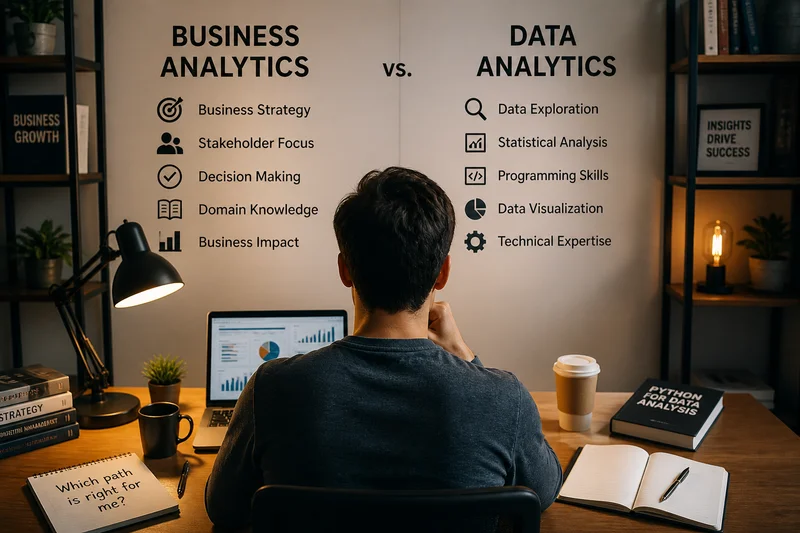
If you’re trying to choose between Business Analytics and Data Analytics in 2026, it probably feels like you’re staring at two identical doors. Both roles deal with data, both pay incredibly well, and both are high in demand.
But once you’re actually sitting at the desk, the "vibe" of these two jobs couldn't be more different. One is for the person who loves solving technical puzzles in a flow state, while the other is for the person who wants to be in the room where the big decisions are made.
At Learnhub Education, we see students get stuck here all the time. Let’s cut through the jargon and talk about what these roles actually look like on a Tuesday afternoon.
The Big Picture: What’s the Goal?
The simplest way to look at it is to ask yourself: Are you interested in the "How" or the "What now?"
Data Analytics: The "How"
Basically, a Data Analyst is the person who goes in and cleans up the mess. Most companies have tons of data, but it’s usually a disaster—misspelled names, duplicate entries, or just random numbers that don't match up. You can't make a big business decision based on broken info.
The analyst's job is to get their hands dirty and "scrub" that data. You're looking for the actual facts buried under all that junk. It’s not just about making pretty charts; it’s about figuring out why the numbers are moving the way they are. You’re finding the "why" so the company doesn't end up flying blind.
Business Analytics is the "What now?"
A Business Analyst takes that "truth" and turns it into a game plan. They don't just care that sales are down; they care about how to fix it. They are the strategists. They bridge the gap between the technical data and the company's actual goals.
The Day-to-Day: What are you actually doing?
A Day in the Life of a Data Analyst:
You’ll likely spend a lot of your morning writing SQL queries to pull data from a server. You’re dealing with "dirty data"—the kind where names are misspelled or dates are missing. You spend hours cleaning that mess up so you can build a dashboard that actually works. You live in tools like Python, R, and SQL. It’s all about technical accuracy and building systems.
A Day in the Life of a Business Analyst:
Your morning is usually spent in meetings. You’re talking to marketing or sales teams to understand their problems. You look at the charts the Data Analysts built and you start connecting the dots. You might spend the afternoon building a presentation to show the leadership team why they should stop spending money on one product and move it to another. It’s all about communication and solving high-level business problems.
The Skill Set: Which "Brain" Do You Have?
This is where you need to be honest about what you actually enjoy doing for eight hours a day.
If you love the "detective work," go for Data Analytics. You’ll need to be comfortable "talking" to computers, writing scripts, and understanding the math behind the patterns. You need the patience to fix broken data sets until they are perfect.
If you’re a "people person" who also likes numbers, Business Analytics is probably your home. You need to understand how a business actually makes money and be a great storyteller. You’re the one who has to explain complex data to people who might not understand math at all.
The Paycheck: What’s the 2026 Reality?
In India right now, both roles are very lucrative. Generally, Business Analysts start with a slightly higher base—often between ₹5.5 Lakhs to ₹9 Lakhs for freshers—because they need more "people skills" and industry knowledge right away.
Data Analysts usually start around ₹4.5 Lakhs to ₹7.5 Lakhs, but don't let that fool you. A highly technical Data Analyst who understands AI and Machine Learning can eventually out-earn almost everyone in the building as they move into senior roles, often hitting ₹20 Lakhs to ₹45 Lakhs after several years.
The Honest Test: Which one is for you?
If you're still on the fence, ask yourself these three things:
Do you like coding? If you love getting lost in a script and fixing bugs, you're a Data Analyst. If coding feels like a chore you’d rather avoid, go for Business Analytics.
Do you like meetings? If the idea of spending your day presenting ideas and talking to managers sounds fun, you’re a Business Analyst. If you’d rather put on headphones and work alone, you’re a Data Analyst.
What’s your "Big Win"? Is your win building a perfectly automated system? Or is your win helping a company save ₹50 Lakhs because of a suggestion you made?
Why the lines are blurring in 2026
Here is the truth: with AI handling the "boring" parts like basic data cleaning, these two roles are merging. Data Analysts are having to become better communicators, and Business Analysts are having to learn a bit of Python.
At Learnhub Education, we always tell our students: Don't just pick a title, pick a skill set. If you can do the math and tell the story, you’ll never be out of a job.
Final Thought
Data Analytics is the Science; Business Analytics is the Art. One finds the gold, the other figures out what to build with it.
Which one feels more like you? Whatever you choose, the demand is only going up. It’s time to stop overthinking and start building those skills.
Ready to get started? We’ll see you in the trenches.
FAQs:
1. Is it just staring at Excel all day?
Excel is a big part of it, especially starting out, but it’s more than that. You’ll use SQL to talk to databases and tools like Tableau or Power BI to turn numbers into pictures that actually make sense to people.
2. Is AI going to take my job in 2026?
AI is great at the boring stuff—like cleaning up data or writing basic code. But it can’t explain "why" a human customer acts the way they do. Your value is in the thinking, not just the clicking.
3. How long does it take to learn the basics?
If you’re consistent, you can get a solid grasp of the core tools (SQL, Excel, and a visualization tool) in about 3 to 6 months. Mastering it, of course, takes longer.
4. Do I really need to learn Python or R?
For a lot of entry-level jobs, you can get by with just SQL and Excel. But if you want the high-paying roles or want to work with really massive data sets, Python is basically your superpower.
5. What is "Dirty Data" anyway?
It’s basically human error. Imagine a list of customers where "Mumbai" is spelled five different ways. If you don't fix that, your report will be totally wrong. Cleaning that up is the "detective work."
6. Is the pay really that good in India?
Yes, it’s one of the highest-paying entry-level fields right now. Starting salaries in hubs like Bengaluru or Mumbai are very competitive, and it only goes up once you specialize.
7. What’s the hardest part of the job?
Communication. It’s one thing to find a pattern; it’s another thing entirely to explain it to a manager who doesn’t understand technical jargon.
8. Do I have to work in an office?
Data is digital, so this is one of the most remote-friendly careers out there. A lot of analysts work from home or in "hybrid" setups.
9. How can Learnhub Education help me?
We focus on the "hustle" and the actual skills you need on the job. We don’t just give you a certificate; we help you build that portfolio and teach you how to think like an analyst.