Phone: +91-9310885321
 Email: support@learnhub4u.com

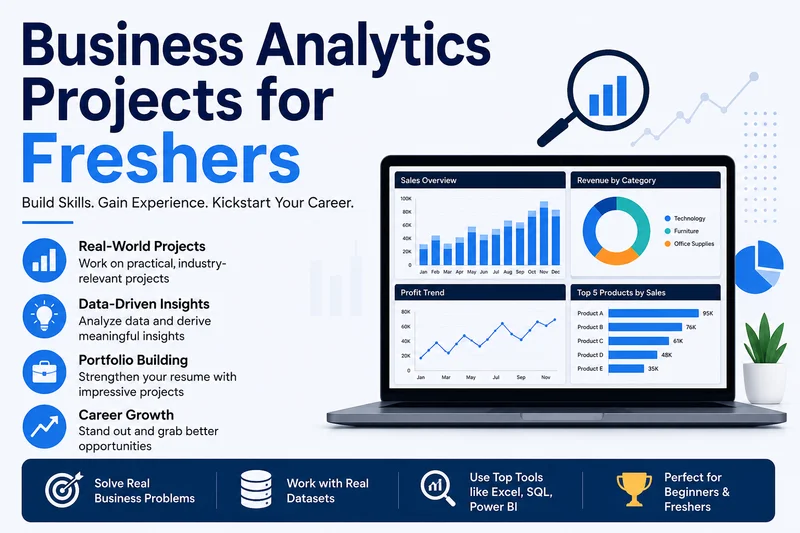
How to Actually Build a Business Analytics Portfolio (Without Looking Like Every Other Fresher)
If you are currently applying for entry-level analyst roles, I can almost guarantee your resume looks exactly like the person next to you. You probably have the Titanic dataset on there, or maybe a basic housing price prediction project you copied from a YouTube tutorial.
Here is the brutal truth: recruiters spend about six seconds looking at your GitHub. If they see the same generic datasets everyone uses, they instantly click away. They don’t want to see if you can write model.fit(). They want to know if you understand how a business actually makes or loses money.
As a fresher, you don’t need 50 projects. You need two or three that look like you actually thought about a real business problem. At Learnhub Education, we see students make the mistake of focusing too much on complex math, when they should be focusing on business logic.
Let’s walk through a few project ideas that you can build right now that will actually make an interviewer stop and ask you questions.
1. The "Why Are People Stopping Their Monthly Subscriptions?" Project
Every single business right now is obsessed with subscriptions—Netflix, Spotify, gyms, SaaS companies. The biggest headache for these companies is "churn" (when a customer cancels their plan).
Most freshers just build a machine learning model that predicts who will leave. That’s boring. A real business analyst figures out why they are leaving and how much it’s costing the company.
How to do it:
Find any dataset that tracks customer activity over time (Kaggle has tons of telecom or gym membership datasets).
Don’t just jump into Python. Start in SQL or Excel.
Group your customers by how long they’ve been around. Do people usually quit after month 2? Or month 6?
Calculate something called RFM (Recency, Frequency, Monetary). Basically, figure out who your best customers are, who is slipping away, and who is already gone.
Build a simple dashboard in Power BI or Tableau. Put a massive number at the very top showing exactly how much money the company lost this month just from people quitting.
Why this works: When you talk about this in an interview, you won’t say, "I got 85% accuracy on my random forest model." You’ll say, "I found out that customers who don't log into the app within their first week have a 70% chance of quitting by month two, costing the company $10k a month."
2. The "Where is the Marketing Budget Being Wasted?" Project
Imagine a local retail brand or a startup. They are spending money on Instagram ads, Google search, TikTok, and maybe some flyers. At the end of the month, they made $50,000 in sales. The CEO has no clue which ad channel actually brought in the customers and which one was a complete waste of cash.
This is where Marketing Mix Modeling comes in. It sounds fancy, but it’s basically just using data to see what works.
How to do it:
You need a dataset that shows weekly or monthly spending on different ad platforms alongside the company’s total sales.
Use basic regression (you can even do this in Excel or Python using Pandas).
You want to see the relationship between spending on a specific platform and the jump in sales.
Look for "diminishing returns." For example, if you double your Instagram budget, do your sales double? Usually, they don't. There's a sweet spot where spending more money stops working.
Why this works: This shows you think like a manager. You’re telling the interviewer that you understand ROI (Return on Investment), which is the favorite word of any business leader.
3. The "We Are Running Out of Stock" Project
Think about a basic e-commerce store or your local grocery delivery app. If they buy too many milk cartons, the milk spoils and they lose money. If they buy too few, they run out, customers get annoyed, and they go buy from a competitor.
Balancing inventory is a massive headache for companies, and it’s a goldmine for data analysts.
How to do it:
Find a historical sales dataset for a retail store.
Look at the sales trends over time. Is there a pattern? Do things sell like crazy on weekends? Do sales spike right before holidays?
Use a basic time-series tool (even simple moving averages in Excel or Python's Prophet library) to predict what demand will look like next week.
Create an alert system in your dashboard that highlights products in "Red" if the stock levels drop below a certain safety net.
Why this works: Supply chain roles are booming right now. Having a project that shows you understand supply, demand, and safety stock makes you instantly employable in retail, logistics, and tech startups.
The Secret to Presenting Your Work
Let’s talk about your GitHub or your portfolio website. Please do not just upload a Jupyter Notebook filled with messy code, random graphs, and no explanations. No one is going to read it.
Instead, write a simple ReadMe file that explains the project like you're talking to a non-technical manager:
The Problem: The company was losing money on X.
The Mess: The data was completely dirty, had missing values, and I spent three days cleaning it up (recruiters love hearing about data cleaning because that’s 80% of the actual job).
The Answer: I built a dashboard/model that showed X, Y, and Z.
The Value: If the company uses this, they can save X amount of dollars.
Wrapping It Up
At the end of the day, tools like SQL, Python, Power BI, and Excel are just tools. They are like a hammer and nails. Anyone can learn how to use a hammer. What companies pay for is the person who knows where to drive the nail to keep the house from falling down.
If you are feeling stuck or overwhelmed trying to figure out how to transition from learning theories to actually working on projects that look professional, that is exactly what we focus on at Learnhub Education. We don't just hand you a certificate; we help you build projects that actually make sense to hiring managers so you can land your first job.
Pick one problem from this list, stop overthinking it, and go find some messy data to play with. You've got this!
FAQs:
1. Do I absolutely need to know Python or R to get my first job?
Honestly? Not always. For a lot of entry-level roles, if you are a wizard at SQL and Excel, you can get your foot in the door. Companies care way more about whether you can query a database and build a clean pivot table than if you can build a massive machine learning model. Python becomes super important later when you want to scale up or do heavy automation.
2. What should I do if a dataset on Kaggle is already perfectly clean?
Mess it up yourself, or don't use it. If you download a perfect CSV file where nothing is missing, you aren't learning anything. Real business data is disgusting—it has typos, missing dates, duplicates, and broken formatting. Go into Excel, delete random chunks of data, change date formats to match three different styles, and then write your script to fix it. That's what makes a project look real.
3. How many projects do I actually need in my portfolio?
Two or three deep, thorough projects are infinitely better than ten shallow ones. If you have ten projects, it tells me you just copied ten tutorials online. If you have two projects where you cleaned the data, built a dashboard, and wrote a summary of what the business should do next, that shows you actually know how to work.
4. Power BI or Tableau—which one should I learn first?
It really doesn't matter as much as people think because they do the exact same thing. If you love the Microsoft ecosystem and Excel, Power BI will feel a bit more natural. If you want something that looks incredibly polished and is widely used in massive tech companies, pick Tableau. Just pick one, get good at it, and don't waste time trying to master both at the start.
5. How do I find "real" business data if I don't have a job yet?
Look for public datasets from governments or cities (like NYC Open Data), or use Google Dataset Search. Another great trick is to find a local small business—like a friend's online clothing store or a local cafe—and offer to clean their spreadsheets for free in exchange for using the anonymized data in your portfolio.
6. Is Excel dead? Should I stop learning it?
Excel is the zombie of the tech world—it will never die. No matter how advanced a company's data stack is, the CEO will almost always ask you to "just dump it into an Excel sheet" so they can look at it during a meeting. If you can't do VLOOKUPs, XLOOKUPs, and Pivot Tables quickly, you will struggle in a real job.
7. What do interviewers actually ask during the technical round?
They will almost always give you a live SQL test where you have to write a JOIN or a GROUP BY statement on a whiteboard or a shared screen. But the question that trips most freshers up is the case study. They’ll ask something vague like: "Our food delivery app sales dropped by 10% last week in Mumbai. How would you investigate why?" They want to hear your thought process, not just code.
8. How do I explain a gap in my project data where things just don't make sense?
Embrace it! If your model or analysis gives a weird result because the data was chaotic, write about that in your project summary. Real business data has massive anomalies (like a random spike in sales because a celebrity mentioned the brand on Instagram). Explaining why the data looks weird shows way more maturity than trying to fake a perfect trendline.